equipoise
the lost art of showing up
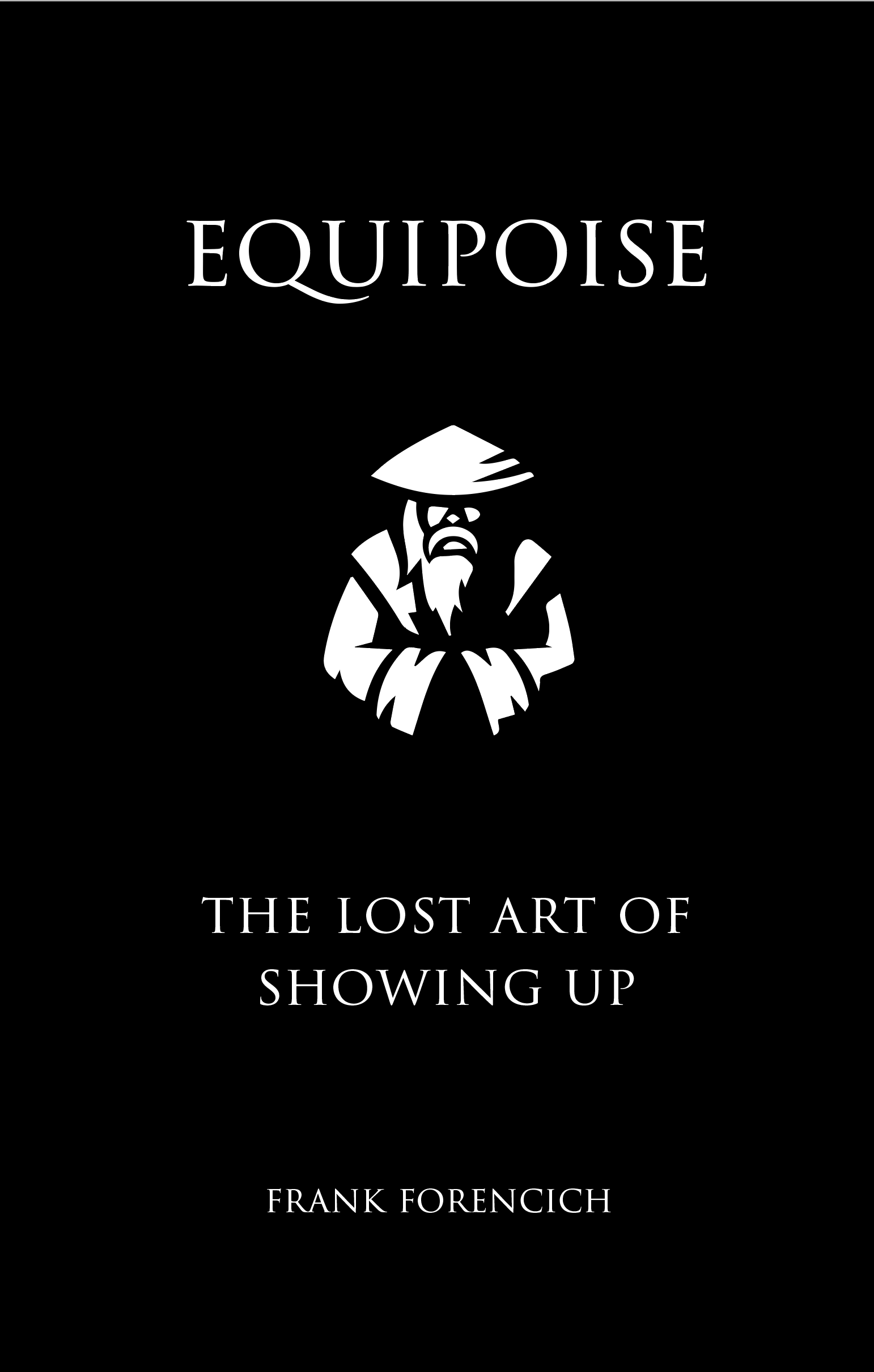
In progress…Projected publication winter 2026
Maybe you learned it growing up. Maybe you learned it in sports, yoga, dance, or the martial arts. Maybe you learned it in the military or in your professional career. Or more likely, as a member of the modern world, you never learned it at all.
Tragically, the practice of showing up with a sense of composure, balance, integrity, dignity, and sincerity is fast becoming a lost art. Overwhelmed by distraction, noise, complexity and confusion, we struggle to function as whole human beings. Stressed and anxious about the state of the world, we retreat into escapism, apathy, helplessness, and drama.
But now more than ever, the art of showing up has become a vital life skill. This book will tell you how.
sample chapter…
origin story
If you want to understand the truth in martial arts you must first throw away the notion of styles or schools, prejudices, likes and dislikes, and so forth. Then, your mind will cease all conflict and come to rest. In this silence, you will see totally and freshly.
Bruce Lee
Graduation from high school is usually pitched as an exciting moment, bursting with promise and potential, a breakthrough into the grand adventure of adulthood. The future beckons, we’re told, bursting with possibility and a wealth of opportunity. Just imagine the wonders that lie ahead. Seize the day, they said. It’s going to be great. Congratulations, and good luck to all of you.
But for me, graduation was nothing of the sort. Adulthood loomed like a dark quagmire of impossible choices, unknowable rules, and severe consequences for error. How could I possibly sort out the arcane mechanics of employment, housing, taxes, and a career, not to mention the almost unimaginable challenge of finding a romantic life partner? I was struck by a sense of paralysis and despair. Surely there had to be a way out.
Even more perplexing was the prospect of navigating the interpersonal conflicts that seemed to be everywhere in the adult world. Aside from the trivial counsel to “be nice” and “do what you’re told,” I had no idea what to do when faced with social disagreements or differences of opinion. Should I stand up and fight back? Should I yield and let people have their way? Mom told me “Don’t fight” but Dad said “Don’t lose” and in a world that seemed altogether unpredictable to my young mind, the question always loomed: Should I be a fighter or a lover? No one seemed to have much of an answer.
At the time, the Cold War was hot and the prospect of nuclear apocalypse seemed all too real. The Vietnam war raged and I could see my college-aged elders fighting back against a system that seemed hell-bent on sending an entire generation to an early death. The Watergate scandal eroded our trust in government and to make matters worse, I could see the early signs of ecological collapse. Books like Silent Spring and The Population Bomb promised a bleak future. How could I possibly find my way in a society that was actively destroying its own life support system? Should I fight back? Work inside the system or outside it? How radical should I be?
Sadly, things were little better in college. My classes were comprehensive and demanding, but practical life lessons were rare. I learned all about human biology and life systems on the brink, but functional advice was almost non-existent. Reading between the lines, all I could gather was that I was expected to do research, write papers, get published and maybe in some mysterious, yet-to-be revealed way, the process would move the needle on the world and my life. Such as it was, my education didn’t really satisfy my craving for real-world solutions. I was still adrift, anxious, and thoroughly unprepared for what lay ahead.
The problem is that no one really told me how to show up. I had parents and elders around me, but everyone in that era simply assumed that tomorrow would be more or less like today. Just learn a trade and you’ll be set for life; follow the rules and you’ll be OK. Widespread, destabilizing systemic change just wasn’t on the radar back then. Aside from a handful of visionaries and futurists, no one saw what was coming. No one anticipated climate chaos, ecological devastation, social injustice or the public health crisis of stress, fear, and polarization. No one understood how radical the change would be or how deeply it would penetrate into the human psyche. With this kind of mindset, it’s no surprise that education was mostly a practical affair. Just solve the immediate problems and get back to work. Everything is going to be OK. The kids are going to be OK.
But the kids were not OK. We knew that something was wrong with society and culture. Our relationship with the world and one another was deeply dysfunctional. It was new and it was moving fast and most of us had no idea what to do. So it was that I made my way off campus and into to a local martial art school, a modest shopping mall dojo that advertised “a philosophical approach.” I had heard rumors about the mysticism and wisdom of the East and I wondered how the monks of the Shaolin temple might deal with the ambiguities of the modern age. Surely, I thought, this would be a place where I could finally get some guidance on the nature of conflict and relationship. Maybe, at long last, I could get some answers to my questions about fighting and living in the midst of ambiguity.
In a very real sense, martial art saved my life. Like a lot of young men, I was impulsive, wild, confused, and afraid. Energy was abundant, but I had no way to channel it. Focus was rare, even nonexistent. I was trouble, a rogue primate, eager for rebellion but with no idea what to do. But sensei gave me what I needed. He told me to put on my training uniform, bow to the mat, and follow directions. “Stand here.” “Bow to your partner.” “Right leg back, punch!” “With a kiai now, punch!” Every movement and action was focused, intentional. There was no slop in this mindbody system, no nonsense, no distractions. Just “Do this.” In the process, everything came together in one singular effort, night after night.
After a few years, I felt the change. For the first time in my life, I felt like I knew what I was doing. My mind and body were coming into focus. At the time I had no explanation for my transformation, but today we recognize the power of this whole body approach. We know that cognition and intelligence are distributed throughout the body. In fact, any modern neuroscientist will tell you that the conversation between mind and body is reciprocal. Give the body a highly focused experience and the spirit is sure to follow.
The experience fired my body and my imagination, but after a few years, life led me to a new town and a new dojo, an aikido school where the objective was to re-direct an attacker’s force using a soft, paradoxical style. “Be non-resistant” my teachers advised. “Don’t interfere with your attacker. Don’t block, kick, or punch. Shift your position and guide your assailant into a safe place.” Suddenly, I was a beginner once again and as my new sensei bluntly put it, everything I knew about martial art was wrong.
Not only did this style feel incredibly awkward, it also sent me into another spiral of confusion. What is the right way to respond to conflict? What’s the best course of action out in the real world where disagreements are complex and dynamic, but rarely physical? What about managing the intricate demands of romance, work, or even international relations? Is it better to meet force with force or blend and re-direct? Now I was at my wits end. When your master teachers disagree with one another about the right course of action in the face of ambiguity, how could I possibly choose?
But along the way, my understanding began to evolve. Maybe martial art wasn’t really about the superiority of any particular technique, but more about the way we move through the world. After all, assailants and relationships are fundamentally unpredictable and, as Heraclitus would have noted, conditions are always changing; we can’t step into the same relational river twice. Or, as one iteration has it, “No man ever fights the same dragon twice.”
In this sense, there can be no single style, technique, or strategy that works in every circumstance. Hard style or soft? Neither answer is correct. People love to argue about the superiority of one method or another, but ultimately, the only thing that really matters is adaptability and fluidity, the ability and willingness to do precisely what the situation demands.
Bruce Lee understood this instinctively. Frustrated with the narrow, rigid practices of existing training styles, he sought something more fundamental. Instead of supposing that an assailant would attack in a particular way, he cleared his mind to embrace all possibilities. And if an attacker is capable of anything, we too must be ready to respond with whatever the situation demands. We might even say that conventional training styles actually move students in the wrong direction. Instead of opening them up to possibility, they narrow the options and leave us even more vulnerable than before.
So it was that Lee created an entirely new approach, one he called jeet kune do, a style of no style, no preference, and no inclination. For Lee, the ultimate metaphor for mastery was to be found, not in any particular method, but in the power and adaptability of water. As he famously advised, “Water can flow or it can crash. Be like water my friend.”
In other words, the ultimate practice doesn’t lie in any particular technique, but rather in the disposition we bring to the encounter. The art lives, not in the execution, but in the state of our minds and bodies in the moments before the decisive act. In this sense, the act itself is somewhat secondary; the proximal goal must always be composure, balance and adaptability. In other words, equipoise.
Of course, Bruce Lee didn’t really have anything to say about today’s monumental challenges–threats like climate change, ecological overshoot, or the catastrophic degradation of our life-support systems. Nor did he have much to say about the perplexing challenges of conflicted interpersonal relationships. Nevertheless, the martial art metaphor provides us with much-needed guidance. Across the modern human experience, all our relations are marked by uncertainty and ambiguity, and all of them demand flexible presence. No matter the domain, there must be times for the water to flow and times for it to crash. We must be capable of both.
This is something that the ancients–particularly those in the Eastern tradition–knew well. Over the course of centuries, teachers crafted a range of disciplines that emphasized the importance of balance, poise, and attention. But sadly, modern culture is rapidly moving in another direction entirely. The practice of equipoise–showing up with dignity and presence, taking responsibility and paying attention to the world and the people around us–is fast becoming a lost art.
To be sure, the practice does survive in some areas of modern life. In the world of sport and athletics, coaches often emphasize the importance of presence. We also see it in yoga, theatre, dance, public speaking, some professional settings, and even in the military. Thousands of teachers and coaches understand, either explicitly or implicitly, that their job description goes beyond basic skill development. But even in these domains, the art of showing up is increasingly overshadowed by secondary considerations and distractions: profit, status, clicks and views, rewards and amusement. Disembodied and dehumanized by glowing screens and an always-on lifestyle, we’ve forgotten the most fundamental skills of all: how to sit, how to stand, how to walk, and most importantly, how to show up with undivided attention.
It may seem odd to think of equipoise–an internal state of mind and body–as any kind of solution to the big ecological and social issues of our day. You might well say that we have bigger fish to fry–large scale policy decisions about energy, transportation, education, industrial agriculture, health care, and economic injustice. It’s also true that equipoise alone isn’t going to move the needle on carbon emissions, habitat destruction, biodiversity depletion, authoritarian rule, or social polarization.
Nevertheless, spirit is vitally important now, especially in light of the catastrophic state of mental, social, and ecological health around the world. This is why it would be a mistake to think of equipoise as just another lifestyle hack or wellness trend. In coming years, showing up is going to become increasingly vital for all of us. As conditions deteriorate, the pressure for escapism of all varieties will increase radically. Ecological and social degradation will bring increased pressure to bear on our spirits, and more of us will be looking for a way out. And in this state, equipoise will become a vitally pro-human and pro-future act.
Showing up sounds basic and it is, but the real beauty of this approach is that it promises to give us back some of what we’ve lost. Equipoise isn’t just the ideal fighting state, it’s also an ideal learning state and an ideal relational state. Action that comes from a place of equipoise is more likely to be effective, functional, satisfying, and meaningful than action that comes from stress, fear, anxiety, habit, or desperation. In other words, equipoise doesn’t just feel better, it also gives us better outcomes.
And in a world that is mostly beyond our control, our presence is something we can control. We are not powerless. We may not have much leverage on the great social and ecological challenges of our day, but we can control the way we show up. No matter how bad things get in our personal lives or across the planet as a whole, we can still have a say in our attitude, our posture, and our perspective. In turn, this sense of control becomes a powerful tonic that’s good for our minds, our bodies, and the people around us. As you’ll see, the experience of showing up in equipoise is its own reward. We do it because it’s a better way to relate to the world and the experience of being alive. It’s simply a better way to live.